Hydraulic & Liquid Manifolds
Hydraulic & Liquid Manifolds
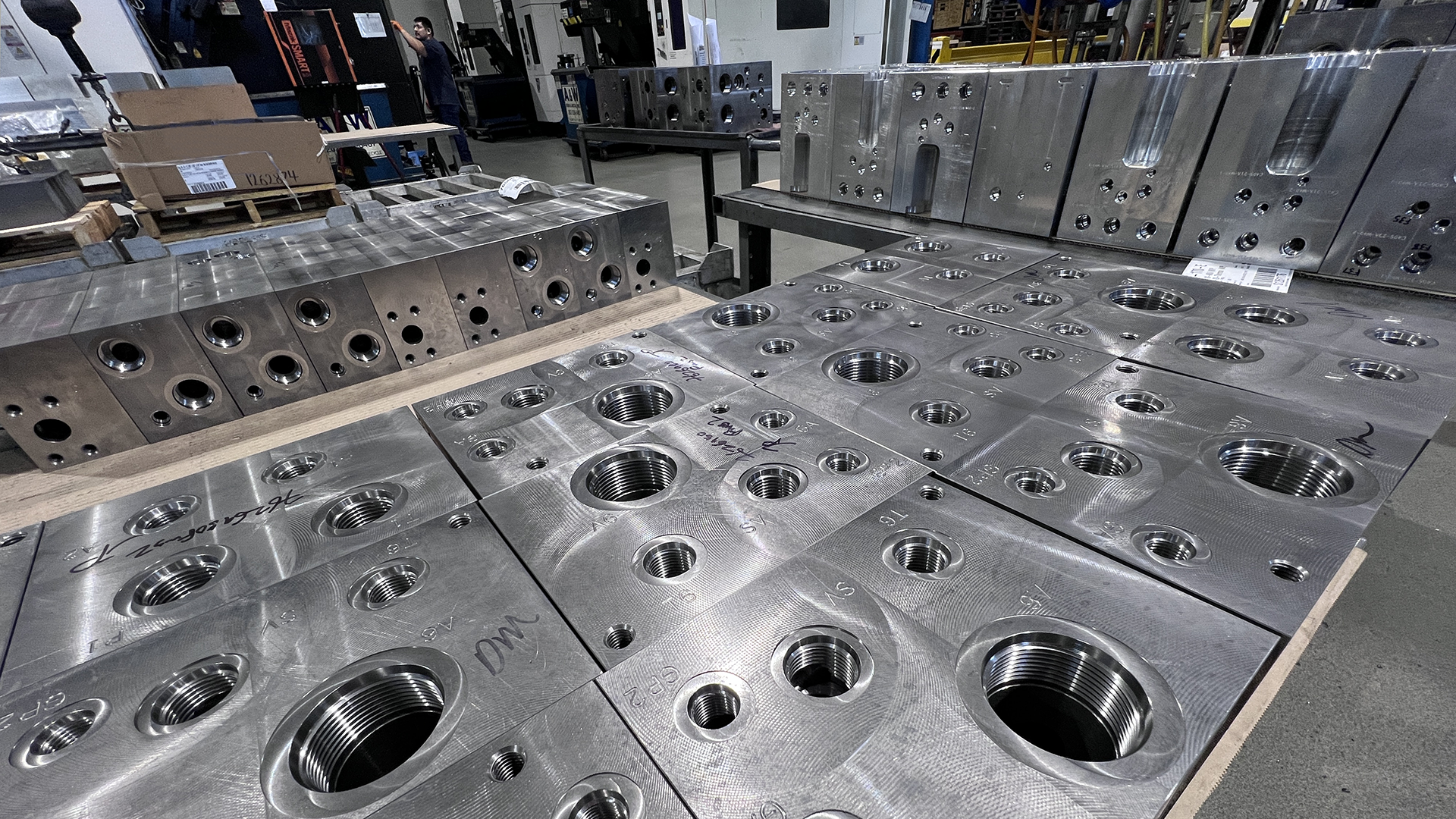
The Midwest leader in hydraulic manifold machining since 1980
Since our modest beginnings in 1980, we have grown to become a premiere manufacturer of hydraulic components—particularly hydraulic manifolds—and are recognized across the industry for our consistent quality and on-time delivery.
Our investment in sophisticated automation and specialized equipment allows us to mass produce parts that range from an inch or two in diameter to several feet wide with hundreds of features. Few shops can compete with our hydraulic manifold machining capability and experience, which is why the nation’s largest distributors and OEMs look to us to complete their complex and essential jobs.
What are hydraulic manifolds?
Hydraulic manifolds are precision-engineered components that control the flow of hydraulic fluid between pumps, actuators, and other parts of a hydraulic system. Acting as the “traffic controller” for fluid movement, they allow complex hydraulic circuits to be compact, efficient, and easy to maintain. By channeling fluid through a series of internal passages, hydraulic manifolds reduce the need for multiple hoses and fittings, improving both performance and reliability.
Because of their critical role in controlling pressure, flow rate, and direction, hydraulic manifolds must be machined to exact tolerances. Even a small imperfection can lead to leaks, inefficiency, or catastrophic equipment failure.
Why precision manufacturing is essential
Manufacturing hydraulic manifolds requires more than just cutting metal—it demands the expertise, skill, and technology of a professional machine shop with state-of-the-art equipment.
High-quality manifolds depend on:
-
Tight tolerances – Internal bores, intersecting passages, and sealing surfaces must meet precise dimensional requirements.
-
Surface finish quality – Rough or uneven surfaces can cause fluid turbulence, pressure drops, or seal damage.
-
Material expertise – The right alloys and treatments are required for strength, corrosion resistance, and long-term durability.
-
Complex drilling and porting – Multiple intersecting holes must be machined without compromising structural integrity.
Without advanced CNC machines, specialized tooling, and experienced machinists, the risk of producing an unreliable manifold rises sharply.
Industries that rely on hydraulic manifolds
Hydraulic manifolds are essential in industries where power, precision, and reliability are non-negotiable:
-
Construction and heavy equipment – Excavators, loaders, and cranes use manifolds to control multiple hydraulic functions from a single power source. Learn more »
-
Agriculture – Tractors, harvesters, and irrigation systems depend on manifolds for smooth operation of hydraulic attachments. Learn more »
-
Oil and gas – Drilling rigs and offshore platforms require high-pressure hydraulic manifolds that can handle extreme pressures and corrosive environments. Learn more »
-
Manufacturing and automation – Presses, injection molding machines, and robotic systems use manifold block machining to streamline hydraulic control circuits. Learn more »
Common machining challenges with hydraulic manifolds
Creating a reliable custom hydraulic manifold is far from simple. Manufacturers must overcome several technical challenges, including:
-
Maintaining alignment in intersecting bores – Misalignment can cause flow restrictions or blockages.
-
Preventing burrs and debris – Even microscopic burrs can damage seals and contaminate the system.
-
Avoiding internal leaks – Imperfect sealing surfaces or incorrect machining can cause cross-port leakage.
-
Ensuring pressure rating compliance – A single flaw can compromise the entire hydraulic system’s safety.
These challenges highlight why not every machine shop is qualified to produce hydraulic system components to industry standards.
Why choosing the right manufacturing partner matters
When you choose a hydraulic manifold manufacturing partner, you’re not just buying a part—you’re investing in the performance and safety of your entire hydraulic system. A qualified vendor will:
-
Have cutting-edge CNC machining capabilities for accuracy and repeatability.
-
Employ skilled machinists who understand the nuances of hydraulic component fabrication.
-
Use quality control processes to verify every manifold meets or exceeds specifications.
-
Offer engineering support to optimize designs for performance and manufacturability.
The right manufacturing partner ensures your manifold is reliable, efficient, and built to withstand years of demanding use—saving you time, money, and downtime.
Contact Us
Questions about our products or services? We are here to help.
Fill out the form below to contact our team by email. We will get back to you as soon as possible.